Hearing loss is a widespread issue in the United States, affecting approximately 40 million people, yet only 25% of those impacted use hearing aids. Contrary to common belief, hearing loss does not discriminate based on age, sex, race, income, or education. While older adults are more vulnerable, younger individuals, including children, are also affected. For instance, 20% of Americans aged 12 and older experience significant hearing loss that impacts communication, and 3 out of every 1,000 American children are born deaf or hard of hearing. Men are more likely to suffer from hearing loss than women, but young women are more proactive in seeking help with hearing aids. Caucasians are three times more likely than African Americans to experience hearing loss, possibly due to melanin's protective effects. Hearing loss is also linked to lower income and higher unemployment rates, as it often goes untreated due to the high cost of hearing aids, which are not covered by Medicare. However, ad
It is a common misconception that hearing loss is synonymous with old age. While many people do develop hearing loss later in life, it is a struggle that does not discriminate against anyone; regardless of their age, sex, race, income, location or education. It might shock you to learn that approximately 40 million Americans (a number that is subject to one’s definition of what constitutes hearing loss) are hearing-impaired. Perhaps even more astonishing, however, is that only 25% of those affected use hearing aids. If you have any preconceived notions about who is most susceptible to hearing loss, read on for a breakdown of the hearing impaired population in America.
Hearing-Impaired Individuals and Age:
While those over the age of 74 are most vulnerable to hearing loss, younger Americans are not immune. Here is a quick breakdown of hearing loss by age, according to the Hearing Health Foundation. Hearing loss affects: - 47% of adults ages 75 and older - 30% of those aged 65 to 74 are affected. - 18% of Americans between the ages of 45 and 54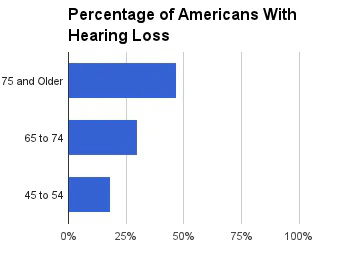
- 20% of Americans 12 and older have hearing loss so profound, it impacts their ability to communicate effectively. - 3 out of every 1000 American children are born deaf or hard of hearing. Despite these statistics, many hearing aid users do not get their first pair until they are nearly 65 years old.
Hearing-Impaired Individuals and Sex:
Studies suggest that considerably more men than women suffer from hearing loss. In fact, of the hearing-impaired, an estimated 60% are men. Despite that discrepancy, young women are more likely to seek the help of hearing aids than their male counterparts. In old age, however, when men and women are equally prone to hearing loss, men are about 50% more likely to wear hearing aids.Hearing-Impaired Individuals and Race:
There has been substantial research concerning the relationship between hearing loss and race—particularly regarding the discrepancy between hearing loss among Caucasians and African Americans. In a study conducted at Johns Hopkins University, it was discovered that Caucasian participants were three times more likely than African Americans to experience hearing loss. Researchers believe that this might be due to a pigment called melanin, which is produced by the cells in the skin and inner ears of African Americans, and might protect them from the damage that can lead to hearing loss.Hearing-Impaired Individuals and Income:
According to a study published in Annals of Otology, Rhinology & Larynology in 2012, there is a relationship between unemployment and being hearing-impaired. In addition to the alleged higher unemployment or partial employment rate for hearing impaired individuals, those who experience hearing loss typically make lower wages than those who do not. David Jung, MD, PhD, one of the study’s coauthors, says while they cannot yet make definitive determinations about the data collected, they are “pretty striking associations.” 95% of Americans with hearing loss would benefit from hearing aids. However, since hearing aids are not covered under Medicare, consumers often have to pay for them out of pocket, which poses a problem for low-income individuals. In spite of these staggering statistics, there is hope for hearing-impaired people. Hearing aid technology advances every day and the sale of affordable hearing aids online and in discount stores has made them more accessible to a wide range of Americans.by Leah Sininsky
The above is the interpretation of What is Life Like for the Hearing Impaired? provided by Chinese hearing aid supplier Shenrui Medical. Link https://www.srmcm.com/Blog/What_is_Life_Like_for_the_Hearing_Impaired.html of this article is welcome to share and forward. For more hearing aid related information, please visit Blog or take a look at our Hearing aids products