Key points:
-
Acoustic neuromas are rare, benign brain tumors that develop on the auditory nerve.
-
They can cause a range of auditory and balance symptoms, including tinnitus, dizziness, mild headaches, and problems with coordination.
-
Treatment options range from "watch and wait" to surgery.
The human ear is connected to the brain via the auditory nerve.
Sometimes, a tumor can grow along this auditory nerve, known as an acoustic neuroma.
While scary, these rare, slow-growing tumors are almost always benign, meaning they will not spread. However, they can cause significant symptoms and require complex brain surgery.
Symptoms of acoustic neuroma
Hearing loss in one ear
One of the most prominent symptoms is single-sided hearing loss, meaning hearing loss in one ear, or unilateral hearing loss.
This causes unique hearing challenges because hearing is no longer "in stereo." Also, speech can sound more muffled, particularly high-pitched parts of speech. Depending on the size and location of the tumor, the degree of hearing loss may range from mild to severe.
Symptoms can be subtle
At first, there may be no symptoms, or they may be so subtle you don't notice them. When an acoustic neuroma grows and presses against neighboring cranial nerves or brain structures, it can cause a variety of physical problems. Because your hearing and balance share a nerve pathway to the brain, both can be affected.
Other symptoms besides hearing loss may include:
- Tinnitus (ringing in the ears)
- Dizziness and problems with balance
- Facial numbness or paralysis
- Difficulty swallowing
- Headaches
- Problems with coordination
- Mental confusion and slurred speech
- Vision problems
- In rare cases, diplacusis, or "double hearing"
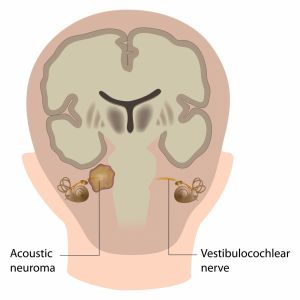
vestibular schwannomas. They grow
on the auditory nerve, which is also called
the vestibulocochlear nerve.
Other names for the condition
According to the National Organization of Rare Diseases (NORD), you may hear doctors use several different terms for the condition, including:
- acoustic neurilemoma
- acoustic neurinoma
- fibroblastoma, perineural
- neurinoma of the acoustic nerve
- neurofibroma of the acoustic nerve
- schwannoma of the acoustic nerve
- vestibular schwannoma
How common are they?
NORS states they occur in one of every 100,000 people who are between the ages of 30 and 60. They affect more women than men. Approximately 2,500 new cases are diagnosed each year.
What causes acoustic neuromas to grow?
Medical professionals aren’t certain what causes acoustic neuromas. Most of these tumors appear spontaneously, without any previous health condition or genetic predisposition.
However, in some cases people inherit a genetic disorder known as neurofibromatosis 2, which causes tumors to grow on nerves.
Other risk factors include loud noise exposure, childhood exposure to low-dose radiation of the head and neck, and a history of benign tumors in the parathyroid glands in the neck.
Diagnosis
Because the majority of these tumors cause subtle symptoms for a long time, they are often difficult to diagnose. If your doctor suspects you have an acoustic neuroma, she may refer you to an audiologist and an otolaryngologist (an ear, nose, throat doctor) or neurotologist to have the following tests:
- Hearing test to determine if you have any hearing loss. Your results will be plotted on an audiogram.
- Brainstem auditory evoked response (BAER) to check your hearing and neurological functions.
- Electronystagmography (ENG) to test your balance. This measures eye movements and can help determine if there is damage to the body's balance system.
- MRIs or CT scans which will provide images of your brain to confirm the presence of the acoustic neuroma.
You may also be referred to an audiovestibular specialist to help you learn to live with the hearing, balance and communication challenges that may arise from having an acoustic neuroma.
Acoustic neuroma treatments
Treatment depends upon the tumor's size, location, and your physical and hearing health. Options include:
- Observation. If you aren’t experiencing any life-threatening or physical difficulties, your physician may suggest a “watch and wait” approach using frequent MRIs and hearing tests to monitor the situation. Due to the slow growing nature of these tumors, yours may never require treatment.
- Microsurgery. If your tumor is causing health problems, a neurosurgeon may recommend removing all or part of the tumor. Partial removal may be required to minimize surgical complications, such as facial paralysis or additional hearing loss.
- Radiation and radiation surgery. If your tumor is growing in an area which makes surgery difficult or risky, your medical team may opt for this noninvasive treatment. In some cases, radioactive devices known as a gamma knife or a cyberknife may be used to deliver the radiation.
- Hearing loss treatment: Depending on your circumstances, your medical and hearing care team may recommend hearing devices, which can include CROS hearing aids, bone-anchored hearing systems, cochlear implants, and hearing aids.
More aggressive treatment is usually recommended for people with neuromas that are near or pressing on the brain stem, which regulates basic functions like breathing. Large tumors may lead to a build-up of cerebrospinal fluid, causing fluid to pool in the brain, known as hydrocephalus. These tumors can be life threatening.
Also, in some cases the tumor may grow back.
Notable stories from survivors
Stories from people who have had acoustic neuromas reveal what the treatment process is like. Former Kansas City Chiefs cheerleader Shanna Adamic spent six years trying to get help for right-sided hearing loss, headaches, vision changes and slurred speech, according to an article published in The Daily Mail. An MRI revealed a golf-ball sized tumor, who was removed during a 13-hour neurosurgery.
Wife of NFL Rams player Matthew Stafford, Kelly Stafford first noticed a loss of balance and coordination, which turned into severe vertigo. An MRI revealed a large tumor. She too faced a long neurosurgery.
Actor Mark Ruffalo had a similar story although his tumor was found quickly. Like Stafford, he still struggles with hearing loss, and also some partial paralysis in his face.
Coping with acoustic neuromas
If you’re diagnosed with an acoustic neuroma, it's normal to feel upset and scared. In most cases, acoustic neuromas are bothersome but not life-threatening. Your medical team will help you decide whether or not surgery is an option and how to cope with any uncomfortable symptoms—such as headaches, dizziness or tinnitus—caused by the tumor.
The most important thing to remember is to follow the recommended plan of treatment and see your healthcare professionals regularly to keep an eye on things.
In the US, the Acoustic Neuroma Association provides support groups and resources, and may be helpful to you as you navigate the healthcare system. If you're in Canada, you can reach out to the Acoustic Neuroma Association of Canada, and the British Acoustic Neuroma Association in the UK.
The above is the interpretation of Acoustic Neuroma: Symptoms, Diagnosis, and Treatment provided by Chinese hearing aid supplier Shenrui Medical. Link https://www.srmcm.com/Blog/Acoustic_Neuroma_Symptoms,_Diagnosis,_and_Treatment.html of this article is welcome to share and forward. For more hearing aid related information, please visit Blog or take a look at our Hearing aids products